The companies of tomorrow won't be run by people alone. Are you ready?
Meet the newest member of your team: an AI agent.
Author: Matas BeniušisPublished updated 10 min read
In short
Until recently, software was designed around how people work: screens, buttons, forms and menus. AI agents often don't need any of that. What matters to them is being able to access data directly, carry out actions efficiently and understand exactly what each action does.
That's why, when I build AI agent systems, I start with the environment in which the agent will operate. I design it for reliable execution, while keeping human-facing controls and decision points wherever a person's approval or involvement genuinely matters.
The key is knowing which parts of everyday work can be entrusted to an agent, and where human judgement remains essential.
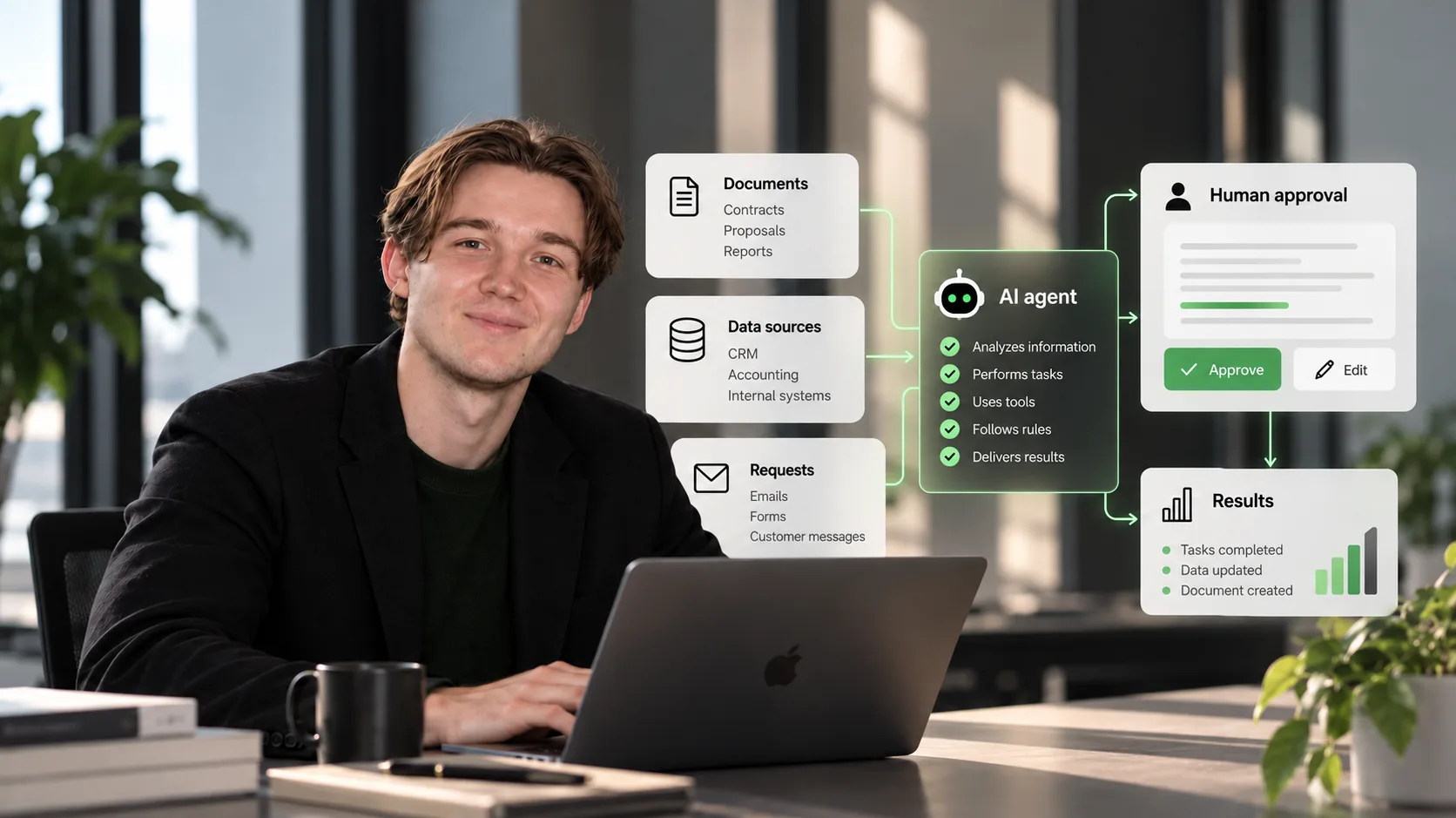
For decades, business software and workplace systems have been built for people. Now AI agents are beginning to use those same systems. The question is: where does that leave us, and how important is the human role?
Excel was built for someone sitting in front of a screen, reviewing spreadsheets and clicking buttons. The same is true of many customer relationship management (CRM), accounting and internal business systems. They all assume a similar way of working: a person looks at information, interprets it, decides what to do next and uses software designed around those decisions.
Over the past three decades, software developers have worked to make that experience easier, faster and more efficient. And they've succeeded. But now there's a new kind of software user in the workplace: the AI agent.
An AI agent doesn't need neatly arranged buttons, colourful charts or animations. It can work directly with a system's data and functions, around the clock.
When we force an agent to work through an interface designed for people, we may introduce unnecessary friction. Give it clear, reliable access to the system, the right data and a well-defined task, and it can carry out a sequence of actions without constant human intervention.
This is where the real shift begins.
Instead of asking how to add AI to the software we already use, we should be asking: how would this software work if an AI agent performed most, or even all, of the work within it?
When AI agents start working independently within your systems
This isn't just a prediction about the future. The technology that makes it possible already exists, continues to improve and is being adopted more widely.
In November 2024, Anthropic, the US AI company behind Claude, introduced an open standard called the Model Context Protocol (MCP). It gives AI systems a consistent way to connect with different data sources, applications and tools, reducing the need to build a separate integration for every connection. Put simply, MCP helps an AI agent discover what it can do in another system and use the functions available to it.
But being able to connect is only part of the equation. The systems themselves also need to support reliable agent operation.
The issue is also explored in a 2026 technical Internet-Draft published through the Internet Engineering Task Force (IETF), which examines how application programming interfaces (APIs) can be designed for AI agents.
An API allows different software systems to exchange information and perform actions directly, without navigating screens, buttons or other elements intended for human users.
Traditionally, a developer reads a system's documentation and writes code that allows applications to exchange data and carry out predefined actions.
An AI agent works differently. Using descriptions of the functions available, it can decide which actions to take, and in what order, to achieve a given objective.
For AI agents to work reliably, the systems they use need to follow a few important principles:
- Clear instructions. The agent needs to understand which functions are available, what each one does and when to use it.
- Safe retries. If an error occurs or a connection drops, the agent should be able to repeat an action without unintended consequences, such as charging a customer twice or creating a duplicate order.
- Only the information that's needed. The agent should receive the data relevant to the task, rather than being overwhelmed with unnecessary detail.
- Useful error messages. A system should explain not only what went wrong, but also what the agent can do to resolve the issue or proceed.
These may sound like minor technical details. In practice, they often determine whether an AI agent can work smoothly and reliably.
So the question isn't just what an agent is capable of. It's also whether the software it works with is well designed for the job.
Where do people still need to be involved?
If an AI agent can complete an entire sequence of tasks on its own, it's reasonable to ask whether people still need to be involved at all.
My aim isn't to remove people from your business processes. It's to draw a clear line between what can be delegated to an AI agent and what still requires human judgement.
For example, an agent can gather information, analyse it and prepare a proposal for a client. But the final price, key contract terms or a payment should still be approved by the person responsible.
That's why I build a straightforward control interface where an employee can review the agent's work, approve it, make changes or reject it.
Once approval is given, the agent can continue independently: sending the proposal to the client, updating records or completing the next steps in the workflow.
A person steps in not because the agent is necessarily unable to do the work, but because some decisions call for human judgement and accountability.
This approach is also explored in an April 2026 research paper by Edward Cheng and Jeshua Cheng, 'A Decoupled Human-in-the-Loop System for Controlled Autonomy in Agentic Workflows'. The authors propose treating human oversight as a distinct part of an agent system, defining in advance when intervention is needed, who makes the decision and how the agent resumes work afterwards.
To me, this is one of the most important design principles: human oversight shouldn't be an afterthought. It should be built into the system's architecture from the outset.
The level of human involvement can also change over time. Initially, an employee might review every task the agent completes. As the system proves reliable, reviews can be limited to exceptions and higher-risk cases. Eventually, clearly defined, low-risk tasks may run independently, with only occasional checks.
In this way, an agent earns greater autonomy through demonstrated performance, while people retain control wherever it matters.
How do you identify work worth delegating to an AI agent?
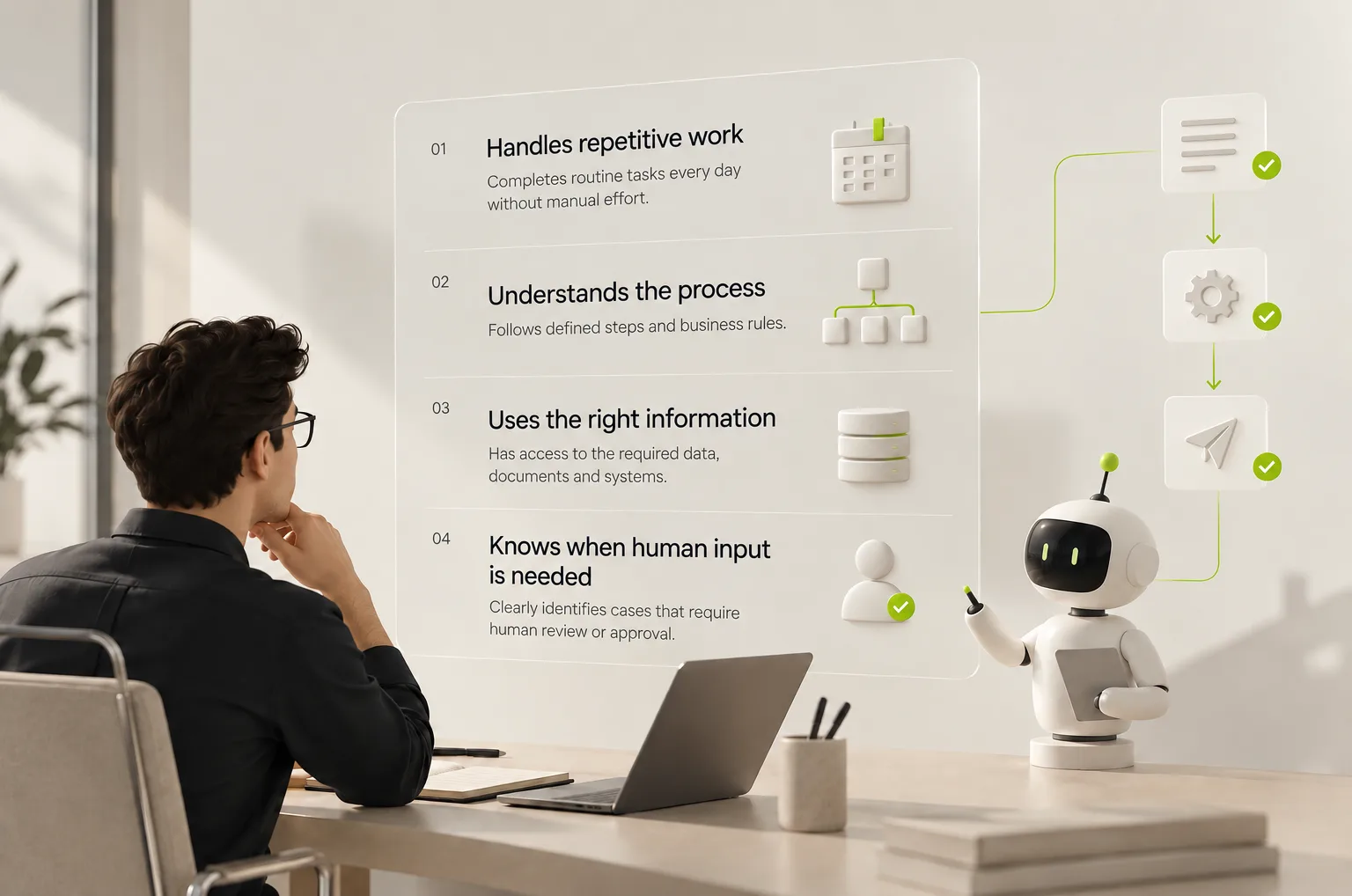
When building AI solutions, the hardest part often isn't choosing the technology. It's understanding which business processes are actually worth automating and handing over to an agent. Plenty of tasks recur in day-to-day operations, but not all are equally suitable.
I therefore start by looking for clear, repeatable workflows: processes with a defined starting point, a sequence of steps and an outcome that can be checked.
I use four main criteria to assess whether a process is a good candidate.
1. The work happens regularly
A task performed every day or every week offers more opportunities to save time than one that only happens once.
2. The process can be clearly described
It should be possible to define which steps need to happen, in what order and according to which rules. If different employees handle the same task in different ways, the first step is to agree on how the process should work and establish a consistent approach.
3. The necessary information is accessible
The agent needs access to the data, documents and systems required for the task. If important information hasn't been recorded, or exists only in one employee's head, it needs to be documented and made accessible before the agent can use it.
4. It's clear where human judgement, review or involvement is needed
You need to establish which actions the agent can take independently and which require a person's assessment or approval.
If human decisions are needed at only a few clearly defined points, those approvals can be built into the automated workflow. But if almost every step calls for individual judgement, automation becomes considerably more difficult.
Together, these four criteria help determine whether a process is worth delegating to an AI agent and whether it's time to build the system to support it.
The agent is given access to the functions it needs, the workflow is defined, and human approval is built in where it genuinely adds value.
At first glance, an employee's role may seem like one large, interconnected job that's difficult to automate. Look more closely, though, and you'll often find distinct, repeatable processes that could be handled by AI agents.
That's why I begin a project by examining not the job description, but how the work actually gets done. Where does the employee get information? Which systems do they search? What steps do they repeat? When do they make judgement calls, and how do they check the results?
Sometimes just a few hours of observation and analysis reveal opportunities for automation that even detailed process documentation fails to capture.
This is often the point at which I can assess whether an AI project will create real value for your business. A technically sophisticated solution isn't necessarily a useful one. It needs to solve an actual problem, save employees time or make operations more efficient, and fit naturally into the way your business works.
What should a business know before introducing AI agents?
You don't need to understand every technical detail to start using AI agents in your business. But before choosing a solution, there are two important questions worth asking the person building it.
1. How will the AI agent work with your existing systems?
Some AI agents operate much like a person: opening applications, clicking buttons, filling in forms and interacting with what's on the screen. This approach can be useful, but it has limitations. A change to a program's layout, button placement or page structure can disrupt the agent's work.
Another approach is to connect the agent directly to your systems through APIs (interfaces that let software applications exchange data and perform actions without using screens or buttons designed for people). This allows the agent to work without relying on a graphical interface, making it generally less sensitive to visual changes and easier to test and monitor in a structured way.
Both approaches have their place. What matters is understanding how your solution will work, how dependable it will be and which technical changes could affect it.
2. At what points will a person need to be involved?
An AI agent can handle many tasks independently, but it's important to decide in advance when an employee's judgement or approval will be required.
For example, an agent might draft a commercial proposal, while a responsible employee approves the pricing and terms before it is sent to the client.
Or an agent might respond to routine customer enquiries on its own, passing more complex cases to a specialist.
A general promise that you'll 'remain in control' isn't enough. You should know exactly what the agent can do independently, when a person will step in and how the quality of its work will be checked.
The answers to these two questions will help you assess not just what an AI solution can do, but whether it can operate reliably in the day-to-day reality of your business.
My role as an AI systems architect
My work doesn't end with building an AI agent. I design the entire system it needs to operate: from integrations with a company's software and data sources to clear operating instructions and mechanisms for human oversight.
All these elements need to work together.
Even the most advanced AI agent won't deliver the expected results if it can't access the right information, carry out the necessary actions or interact reliably with other systems.
What matters most to me isn't how much an AI agent can theoretically do. It's the value it delivers and how reliably it performs in the everyday running of your business.
When the solution is complete, I hand it over to the client along with the source code, necessary access credentials and documentation. That way, your team can not only use the system, but also maintain and improve it independently.
There's a great deal of discussion about what AI agents can do, but far less about the software environments in which they'll actually work.
I believe this is where one of the most significant technological shifts of the coming years will take place. Software will increasingly be built not only for people, but also for AI agents that can use its functions directly and complete more tasks independently.
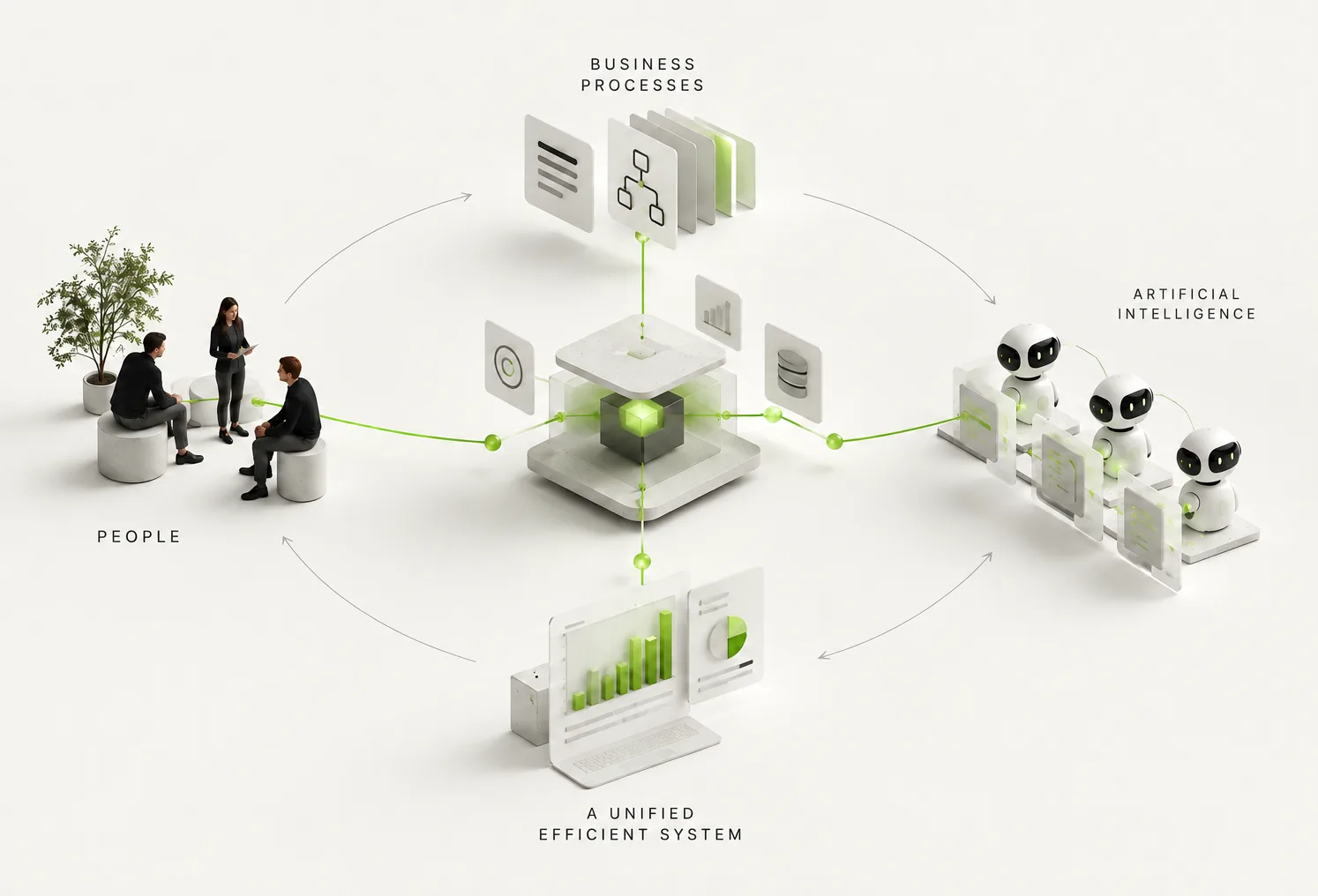
The organisations of tomorrow won't be defined by having the most advanced AI tools. They'll be defined by how well they bring people, artificial intelligence and business processes together into one effective, connected system.
If you'd like to find out which processes in your business could be delegated to AI, let's start with an AI consultation or an assessment of your operations.
If you already know which tasks you'd like to hand over to agents, we can discuss building an AI agent team for your business.
Sources
Ready to spend less time on the work that slows you down?
Let's start with a free 15–20 minute call. Tell me what you're looking to achieve, and I'll help you see where AI could make a real difference, what it would take and whether it's worth pursuing. If AI isn't the right solution, I'll tell you.
Not more AI. More value from AI. Solutions built around you, your team and your goals.